Behind the Semantic Layer: The Context Gap in AI Analytics
By Ignite AI team
The Uncomfortable Truth About “Clean” Data
Here’s a scenario most enterprise data leaders will recognize: a modern AI analytics platform and a well-governed data lake. The CEO asks, “What’s our customer retention by segment?” and three dashboards return three different answers.
The tables and ETL are fine. The problem is the semantic gap — the missing mapping between columns and business meaning. Statistical profiling may show “2.3% nulls” or “normal distribution,” but it won’t tell you that contract value excludes add-ons, was calculated in local currency, and is owned by Finance. That context matters for any production decision, intelligence, or automated reporting.
The Root Cause: Statistical Profiling Was Built for a Different Era
Traditional data profiling answers technical questions: Is the column populated? Are there duplicates? But modern consumers need meaning:
Business analysts asking natural-language questions;
Autonomous agents producing SQL from prompts;
Semantic layers mapping business concepts to physical tables;
Governance teams classifying sensitive data at scale.
For modern use cases, you need semantic enrichment, metadata management, and data lineage that record not just the shape of the data, but what the data means and how it’s used.
Framework: The Four Dimensions of Data Context
When we evaluate data understanding, unlike traditional methods, four dimensions matter. Most teams stop at the first.
Dimension
What It Captures
Why It Matters
Statistical
Distributions, nulls, patterns, outliers
Data quality baseline
Structural
Relationships, keys, hierarchies, grain
Join accuracy, aggregation safety
Semantic
Business meaning, units, classifications
Query correctness, governance
Behavioral
How data changes, usage patterns, lineage
Trust, freshness, relevance
While some other organizations may have invested in the second. Very few have systematically addressed the third and fourth.
The compounding problem? These dimensions aren’t independent. A semantic misunderstanding (mistaking the ID column as a measure) leads to structural errors (wrong joins), which surface as statistical anomalies (impossible aggregations) that erode behavioral trust (people stop using the data).
A robust context-aware profiling capability captures these dimensions simultaneously, enabling your BI semantic layer to power reliable analytics and automated answers.
A Real-World Scenario: The Quarterly Review That Went Sideways
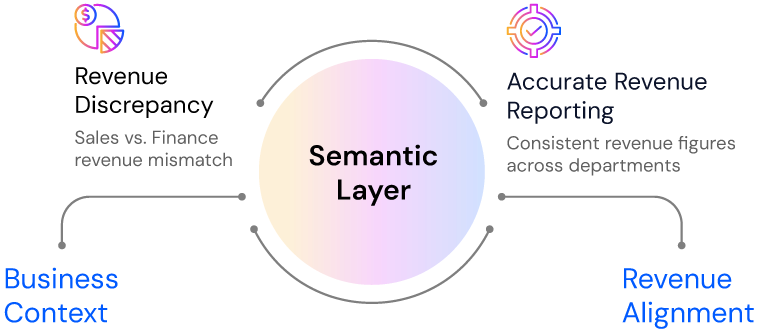
A mid-sized B2B software company migrated to a modern stack and rolled out a self-service BI with a semantic layer. During a Q3 executive review, the VP of Sales reported $18.2 million in closed-won bookings; the CFO’s dashboard showed $14.8 million in recognized revenue. Both numbers were technically correct.
Root cause: two different interpretations of revenue. Sales reported the total contract value at signature (bookings). Finance reported revenue recognized under ASC 606. Both columns were named revenue, and the original semantic mappings didn’t include sufficient business context or lineage notes. The statistical profiles were green. The semantic meaning was missing.
This type of error is exactly what semantic layer implementation and context-aware profiling are meant to prevent.
What to Watch For (Pitfalls)
Over-reliance on column names: A column name is a hint — never a guarantee.
Static profiling: Context drifts after process changes or migrations.
One-time semantic projects: Semantic understanding must evolve with the business, not be a single implementation.
Ignoring tribal knowledge: Institutional context lives with people; capture it in metadata and governance flows.
Practical Steps: From Catalog to Context
Enrich catalog metadata with owner, calculation method, units, and typical use cases. This powers both human discovery and ML-assisted mapping.
Instrument usage telemetry so behavioral dimension data (who uses which object, how often) feeds into trust signals.
Automate lineage capture and link it to semantic definitions so downstream dashboards surface relevant context.
Add human validation gates for critical metrics (e.g., ARR, churn) so subject-matter experts certify definitions.
Use AI to suggest mappings but require explicit human approval — combine ML-led discovery with curated governance.
These steps help organizations operationalize data governance best practices and lock down consistent enterprise metrics across dashboards, notebooks, and AI assistants.
What’s Next in the Series
In the next post, we’ll walk through an architecture for context-aware profiling: ingestion patterns, evaluation criteria, and governance guardrails that make semantic layers trustworthy at scale.
Discussion Questions
How does your organization capture business meaning beyond schema documentation?
Have you seen analytics errors caused by semantic misunderstanding rather than data-quality problems?
Where could AI augment semantic enrichment in your data stack versus where human curation is required?